
Electric Vehicle Towing in Melbourne: What EV Owners Need to Know Before Calling a Tow Truck
Electric Vehicle Towing is becoming an increasingly important service as electric vehicles are no longer a niche choice on Melbourne roads. In May 2026, EVs accounted for over 20 percent of all new light vehicle sales in Australia, more than double the market share recorded just twelve months earlier. Tesla, BYD, Kia, Hyundai, BMW, Mercedes, Polestar, and a growing list of Chinese-brand EVs are appearing in driveways right across Melbourne’s suburbs, from Toorak and Brighton to Craigieburn and Werribee.
With this surge in EV ownership comes a problem that most Melbourne drivers have never thought about until the moment it becomes urgent: what happens when your electric vehicle breaks down, runs out of charge, or needs to be transported, and you need a tow truck?
The answer matters far more for EV owners than it does for drivers of petrol or diesel vehicles. Towing an electric vehicle incorrectly can cause serious, permanent, and expensive damage to the motor, battery management system, and drivetrain. And the majority of standard tow trucks operating in Melbourne are not equipped or trained to handle EVs safely.
This guide covers everything EV owners in Melbourne need to know before they ever need to make that call.
Why Electric Vehicles Cannot Be Towed the Same Way as Petrol Cars
To understand why EV towing requires a completely different approach, you need to understand what happens inside an electric motor when its wheels spin.
In a conventional petrol or diesel vehicle, the engine is mechanically decoupled from the drivetrain when the vehicle is in neutral. The wheels can rotate freely without causing any damage to internal components. This is why wheel-lift towing, which lifts the front or rear wheels while the other pair rolls along the road surface, is safe for most standard petrol vehicles.
An electric vehicle works fundamentally differently. The electric motor in an EV is directly connected to the drive wheels with no traditional clutch or neutral gear to decouple them. When the drive wheels of an electric vehicle rotate, whether the car is powered on or not, the motor spins as well. When a motor spins, it generates electricity through a process called back-EMF, or back electromotive force.
In a powered-on EV, this generated electricity feeds back into the battery as regenerative braking, which is a normal and intended function. But when the vehicle is powered off and being towed with its wheels on the ground, this back-EMF current has nowhere safe to go. It flows into the high-voltage battery pack and motor control circuitry in an uncontrolled way, generating heat and electrical stress on components that are not designed to handle unmanaged current input. The result can be permanent damage to the electric motor, the inverter, the battery management system, or all three simultaneously.
Towing an electric car with wheels on the ground risks permanent damage to the electric motor, battery management system, and regenerative braking components. All major EV manufacturers including Tesla, Rivian, GM, Ford, Hyundai, and Nissan require flatbed transport with all four wheels off the ground for any tow exceeding a few feet. Violating this requirement voids the powertrain warranty on most models.
For Melbourne EV owners, this is not a theoretical risk. It is a real and costly one. Electric motor replacements and battery management system repairs are among the most expensive repairs in the automotive industry. A single incident of incorrect towing can generate a repair bill that runs to tens of thousands of dollars and voids the manufacturer warranty that would otherwise cover those repairs.
The Only Safe Way to Tow an Electric Vehicle: Flatbed and Tilt Tray
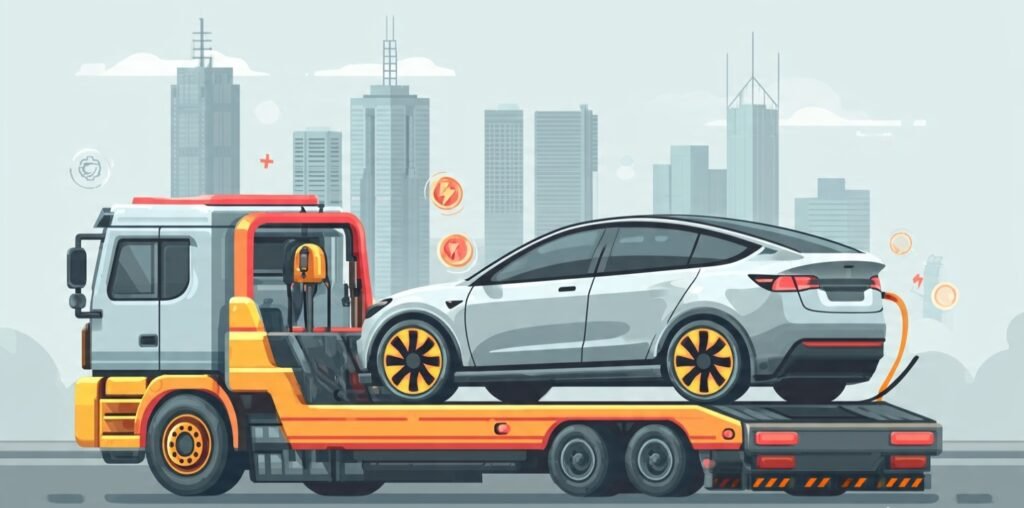
Flatbed towing is easily the safest way to transport electric vehicles. This method lifts all four wheels off the ground and eliminates risks to the drivetrain or electrical systems. Your EV’s specialised low-resistance tyres and delicate underbody components stay safe with this method, which is why Tesla and most other EV manufacturers recommend flatbed towing in their owner’s manuals.
A flatbed or tilt tray truck uses a hydraulic platform that lowers to allow the vehicle to be driven or winched onto a flat surface. Once loaded, all four wheels are completely off the ground for the entire journey. There is no motor rotation, no back-EMF generation, and no electrical stress on any component. The vehicle arrives at its destination in exactly the same condition it was loaded.
In Australia, tilt tray trucks are the standard form of flatbed transport used by professional towing operators. The tilt tray lowers at an angle to allow loading and then returns to a horizontal position for transit. For electric vehicles with low ground clearance, such as the Tesla Model 3, Model Y, or Polestar 2, the loading angle and ramp approach need to be managed carefully by an experienced operator to avoid scraping the underside of the vehicle. This is a skill that comes with experience in handling EVs specifically, not just general towing competence.
At Cheap Tow, every electric vehicle we transport is handled on a flatbed tilt tray truck. This is not a premium option or an upgrade you need to request. It is our standard operating procedure for every EV tow across Melbourne and Victoria. You can confirm our approach and request a quote through our prestige car towing page which covers our flatbed capability in detail.
Transport Mode: What You Must Do Before Your EV Is Loaded
One of the most important things an EV owner can do when waiting for a tow truck is activate the vehicle’s transport mode or tow mode before the truck arrives. Most modern electric vehicles have a dedicated mode that prepares the car for flatbed transport by disabling regenerative braking and allowing the wheels to roll freely without generating current even if the vehicle is partially moved during loading.
When calling roadside assistance, specify flatbed only at the time of the call. Most EVs have a dedicated transport or tow mode that disables regenerative braking and allows the wheels to roll freely without generating current. For Tesla vehicles, this is found under Settings, then Service, then Towing.
For other common EVs in Melbourne, transport or tow mode is typically accessible through the vehicle’s infotainment system under a Service or Vehicle Settings menu. If you are unsure how to activate this on your specific vehicle, consult your owner’s manual or contact the manufacturer’s customer support line before the tow truck arrives. The few minutes this takes can prevent significant damage during the loading process.
If your vehicle has completely run out of charge and cannot power on its infotainment system, inform the towing operator immediately. An experienced EV towing specialist will know how to handle a completely discharged vehicle safely, which typically involves a slow, controlled winch-loading process rather than driving the vehicle onto the tray.
EV Towing in Melbourne: Model by Model Guide
EV ownership in Melbourne spans a wide range of brands and models, each with its own specific towing requirements. Here is a practical reference for the most common electric vehicles on Melbourne roads in 2026.
Tesla Model 3 and Model Y
Tesla is the most common electric vehicle brand in Melbourne and both the Model 3 and Model Y require flatbed towing exclusively. Tesla’s owner documentation is unambiguous on this point. Both models feature an all-wheel drive option with motors on both axles, meaning both pairs of wheels are driven wheels and neither pair can safely rotate while the vehicle is being towed. The Model Y, which is Tesla’s best-selling vehicle in Australia, also features a relatively low profile that requires careful ramp angle management during loading.
BYD Atto 3, Seal, and Dolphin
BYD became Australia’s best-selling EV brand in 2026, which means there are now a significant number of BYD vehicles on Melbourne roads. BYD’s electric models use a permanent magnet synchronous motor configuration that carries the same flat-tow prohibition as Tesla. All BYD EV models should be transported on a flatbed with all four wheels off the ground.
Kia EV6 and EV9
Kia’s electric vehicles use an 800-volt electrical architecture and permanent magnet motors. The EV6 and EV9 both specify flatbed-only transport in their owner documentation. The EV6 in particular has a low ride height that requires attention to loading angle and approach.
Hyundai Ioniq 5 and Ioniq 6
Hyundai’s Ioniq range shares the same 800-volt platform as the Kia EV6. Both the Ioniq 5 and Ioniq 6 require flatbed transport. Hyundai’s official roadside assistance documentation confirms that these models must not be towed with wheels in contact with the road surface.
BMW iX, i4, and i7
BMW’s electric lineup features all-wheel drive configurations across most variants. The iX, i4 M50, and i7 all have drive motors on both axles. BMW’s own roadside assistance guidelines specify flatbed transport for all xDrive electric models. The premium paint finishes on BMW electric vehicles also make careful, soft-strap loading essential.
Mercedes EQS, EQE, and EQB
Mercedes-Benz electric vehicles similarly require flatbed towing. The EQS in particular has an extremely low drag coefficient body design that sits close to the ground, making the loading approach critical. Any Mercedes EQ-series vehicle should only be handled by a towing operator with confirmed flatbed capability and experience with low-clearance EVs.
Polestar 2
Polestar, Volvo’s electric vehicle brand, specifies flatbed towing for the Polestar 2. The vehicle’s all-wheel drive configuration and permanent magnet motor design create the same back-EMF risk as other EV platforms if the wheels are allowed to rotate while towed.
MG ZS EV and MG4
MG’s electric vehicles are among the most affordable EVs in Australia and have therefore become common on Melbourne roads relatively quickly. Both the ZS EV and the MG4 require flatbed transport. Despite their lower price point compared to premium EV brands, the same electrical physics apply and the same risk of damage from incorrect towing exists.
What Happens if Your EV Runs Out of Charge in Melbourne
Running out of charge is the EV equivalent of running out of petrol, but it has some important differences in terms of how you should respond and what to expect from roadside assistance.
If your EV runs low on charge while driving, most vehicles will alert you well in advance and guide you to the nearest charging station using the navigation system. In Melbourne, the public charging network has expanded significantly and fast charging stations are now available across the CBD, major shopping centres, and along key arterial routes. If you have access to a charger and can reach it, doing so is always preferable to a tow.
If the vehicle runs completely flat before you reach a charger, or if the charge level drops too low to safely continue driving, the vehicle will enter a reduced-power mode and eventually stop. At this point you need roadside assistance. Some roadside assistance providers in Australia now carry mobile charging units that can provide enough charge to get you to a nearby charging station, which avoids the need for a tow altogether. It is worth checking whether your roadside assistance membership includes this service.
If a charge top-up is not available or if your vehicle has stopped in a location where charging on-site is not practical, a flatbed tow to the nearest compatible charging station or to your preferred service destination is the solution. When you call for a tow, always state clearly that the vehicle is an electric vehicle and that you require a flatbed truck. Do not accept a wheel-lift truck regardless of how quickly one might be available. The wait for a flatbed truck is always worth it compared to the repair bill that follows incorrect towing.
Our roadside assistance service covers breakdowns across Melbourne and Victoria and our team is familiar with the specific requirements of EV recovery. For breakdowns on major Melbourne routes including the Monash Freeway, West Gate Freeway, CityLink, or Eastern Freeway, our emergency towing service prioritises rapid dispatch with the correct equipment.
Why Standard Roadside Assistance Often Falls Short for EVs
Many Melbourne drivers rely on their comprehensive car insurance or a standard roadside assistance membership for breakdown coverage. While these services are valuable, there are important limitations to be aware of when it comes to electric vehicle recovery specifically.
Not all roadside assistance fleets in Australia have invested in sufficient flatbed truck capacity. A membership that guarantees a tow truck within a certain timeframe does not guarantee that the truck dispatched will be a flatbed. In situations where the dispatcher sends a wheel-lift truck because no flatbed is immediately available, the driver may attempt the tow anyway or leave you waiting while a flatbed is sourced from elsewhere.
The safest approach for EV owners is to have the direct number of a specialist towing operator with confirmed flatbed capability saved in your phone before you ever need it. When your vehicle breaks down is not the time to be researching towing options while sitting on the side of a freeway.
Some EV manufacturers also provide direct roadside assistance through their own networks. The RACV provides guidance on EV towing requirements and recommends that EV owners verify the truck type in advance when requesting assistance for electric vehicles. Regardless of which roadside assistance channel you use, always specify flatbed when making the call.
Breakdown on Melbourne Freeways: What EV Drivers Need to Know
Breaking down on a freeway in Melbourne is stressful for any driver but there are specific considerations for EV drivers that are worth understanding.
VicRoads and Victoria Police manage Melbourne’s freeways under specific incident response protocols. A broken-down vehicle on the Monash, CityLink, West Gate, or Eastern Freeway creates a hazard and response times from both traffic management and towing operators are typically prioritised accordingly. If your EV stops on a freeway, turn on your hazard lights immediately, exit the vehicle if it is safe to do so and move behind the roadside barrier, and call for assistance immediately.
When speaking to the dispatcher, be specific: state that the vehicle is an electric vehicle, give the make and model, and confirm that you require a flatbed tilt tray truck. If you are on a tolled section of road such as CityLink or EastLink, inform the operator of your exact location using the kilometre marker signs visible from the roadside.
Our breakdown support page has more detail on how we handle freeway breakdown situations across the Melbourne metropolitan area, and our dispatch team is available around the clock on 0470 320 481 to respond to EV breakdowns across all major Melbourne routes.
EV Towing and Manufacturer Warranty: What Melbourne Owners Need to Know
One of the most important and least understood aspects of EV towing for Melbourne drivers is the impact on manufacturer warranty. Most EV manufacturers include explicit language in their warranty documentation stating that damage caused by improper towing, specifically flat towing or wheel-lift towing that causes the drive wheels to rotate, is excluded from warranty coverage.
This means that if a tow truck driver uses a wheel-lift on your Tesla Model Y or your BYD Atto 3, and the motor or battery system is subsequently damaged, the manufacturer can and will deny the warranty claim. The repair cost falls entirely on you.
This is not a theoretical scenario. It is a real risk that increases as EV ownership grows and as towing operators without proper EV training encounter more electric vehicles on Melbourne roads. Protecting your warranty is a direct financial reason to insist on flatbed towing every time, without exception.
The Electric Vehicle Council of Australia represents the interests of EV owners and industry stakeholders in Australia and provides accessible guidance on EV ownership rights and best practices, including roadside recovery recommendations.
How EV Towing Differs for Plug-In Hybrid Vehicles
Melbourne also has a growing number of plug-in hybrid vehicles, or PHEVs, on its roads. Models such as the Mitsubishi Outlander PHEV, BYD Shark, Toyota RAV4 PHEV, and Volvo XC60 Recharge combine a petrol engine with an electric motor and a rechargeable battery.
For PHEV owners, the towing rules are less absolute than for pure EVs but still require care. Many PHEVs use their electric motor to drive either the rear axle or as part of the primary drivetrain, which means flat towing restrictions may apply depending on the specific configuration of the vehicle. Always check the owner’s manual for your specific PHEV model before accepting any tow, and when in doubt, request a flatbed.
The safest and simplest approach regardless of whether your vehicle is a BEV or a PHEV is to use a flatbed operator every time. It removes all ambiguity and eliminates any risk of warranty-voiding damage.
Choosing the Right EV Towing Operator in Melbourne
As EV ownership in Melbourne grows, the number of towing operators claiming to handle EVs will also grow. Not all of these claims are backed by the right equipment or training. Here is what to look for when choosing a towing operator for your electric vehicle.
Confirm flatbed or tilt tray capability before the truck is dispatched. A straightforward yes from the dispatcher is the answer you need. Anything that involves a hedge, a qualification, or a suggestion that wheel-lift will be fine in this case is not acceptable.
Ask whether the operator’s drivers have specific experience with EV loading. Activating transport mode, approaching low-clearance EVs with the correct ramp angle, and securing an EV on a flatbed using appropriate tie-down points are all skills that require familiarity with specific models.
Confirm insurance coverage is appropriate for the value of the vehicle. Electric vehicles are frequently premium-price assets and the towing operator’s transit insurance should reflect that.
At Cheap Tow, we tick all of these boxes. Our fleet includes flatbed tilt tray trucks operated by experienced drivers who handle EVs regularly across the Melbourne metropolitan area and Victoria. We are available 24 hours a day, seven days a week, and our response times across Melbourne are among the fastest in the market. Our services cover Melbourne, all of Victoria, and interstate routes for EV transport over longer distances via our interstate towing service.
To get an instant quote for EV towing anywhere in Melbourne or Victoria, visit our get a quote page or call us directly on 0470 320 481.
Frequently Asked Questions About Electric Vehicle Towing in Melbourne
Can I use my standard roadside assistance membership for EV towing?
Yes, but you must specify that the vehicle is an EV and that you require a flatbed truck when you call. Do not accept a wheel-lift dispatch. If your membership provider cannot guarantee a flatbed, contact a specialist towing operator directly.
What if my EV has completely run out of charge and will not power on?
A fully discharged EV that cannot power its infotainment system cannot activate transport mode in the usual way. Inform the towing operator immediately. An experienced EV tow operator will use a slow winch-loading process to bring the vehicle onto the flatbed without causing wheel rotation.
Is EV towing more expensive than towing a petrol car in Melbourne?
Flatbed towing is priced higher than wheel-lift towing in general because it requires a more expensive truck and a more careful process. However, the cost difference is modest compared to the repair bill from incorrect towing. At Cheap Tow, we offer competitive pricing on EV flatbed towing across Melbourne. Call 0470 320 481 for an instant quote.
Does towing void my EV warranty?
Correct flatbed towing does not void your warranty. Incorrect towing that causes the drive wheels to rotate during transport can void your powertrain warranty under the terms of most EV manufacturers. This is why insisting on flatbed-only is both a safety and a financial decision.
Do you tow EVs across all Melbourne suburbs?
Yes. Cheap Tow covers all Melbourne suburbs including the CBD and inner suburbs, northern suburbs such as Campbellfield, Broadmeadows, Epping, and Craigieburn, western suburbs including Sunshine and Werribee, eastern suburbs including Box Hill, Ringwood, and Knox, and southern suburbs including Frankston and Dandenong. We also cover all of Victoria and interstate routes.
Can you tow a PHEV as well as a full EV?
Yes. We handle both pure electric vehicles and plug-in hybrid vehicles. Always inform us of the specific make and model when you call so we can confirm the correct loading approach for your vehicle.
Final Thoughts
EV ownership in Melbourne is growing faster than at any point in Australia’s automotive history. In May 2026, EVs accounted for over 20 percent of new light vehicle sales in Australia, more than double the share recorded in May 2025. As more Melburnians make the switch to electric, the importance of understanding how to handle an EV breakdown correctly becomes more relevant every month.
The core message is simple: electric vehicles must only be towed on a flatbed, with all four wheels off the ground, with transport mode activated where possible, by an operator who knows what they are doing. Any other approach carries the risk of permanent, expensive, warranty-voiding damage.
Cheap Tow is Melbourne’s trusted 24/7 flatbed towing specialist for electric vehicles, prestige cars, and all vehicle types across Victoria and interstate. Our team understands EV towing requirements and is equipped to handle your vehicle correctly from the moment we arrive.
Save our number now before you need it: 0470 320 481. You can also read more about how we handle high-value and specialist vehicles in our blog on prestige and luxury car towing in Melbourne and find out more about our full service offering on our Melbourne towing services page.

