
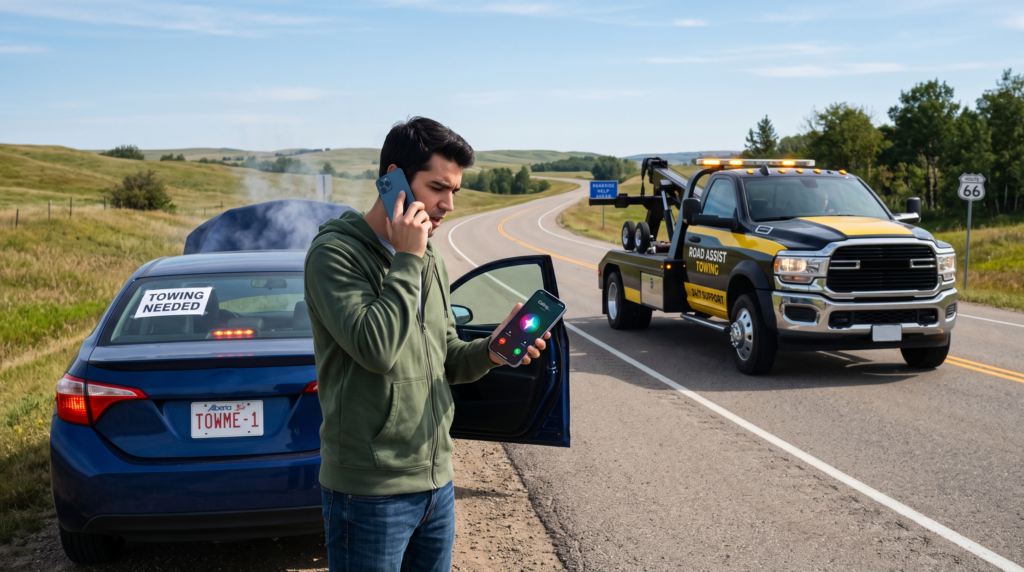
Your car stalls on the Monash Freeway during peak hour. Your hands are shaking, traffic is banking up behind you, and typing a search query is the last thing you want to do. So you say it out loud instead: “Hey Siri, call a tow truck near me.” Or “Hey Google, find emergency towing near me.”
This is no longer a rare habit. It is becoming the default way Australians search for urgent, local help, and it changes how towing companies need to show up online. This guide explains exactly how voice search towing works, what Siri, Google Assistant, and Alexa actually do when you ask them for a tow truck, and how to phrase your request so you get help faster.
Why Voice Search Is Taking Over Roadside Emergencies
Typing while stressed, standing on a busy roadside, or sitting in a car with a dead battery is inconvenient at best and dangerous at worst. Voice search removes that friction entirely, which is exactly why adoption has grown so quickly in Australia. Recent data shows that roughly 57 percent of Australians now use voice search in some form, a trend driven largely by smartphone assistants built into everyday use (SerpWatch, 2026).
For breakdowns specifically, voice search makes even more sense than for everyday shopping or entertainment queries. You are usually one-handed, distracted by hazard lights, or trying to keep an eye on your kids in the back seat. Saying “find me a tow truck” is faster and safer than typing it, which is why voice-driven, local, urgent-intent searches are growing fastest in exactly this kind of situation.
This shift matters just as much for towing businesses as it does for drivers. If a company’s website and Google Business Profile are not structured to answer natural, spoken questions, they simply will not appear when a stranded driver asks their phone for help.
What Actually Happens When You Ask Siri or Google Assistant for a Tow Truck
When you say “Hey Google, call a tow truck near me,” the assistant does not create original content. It searches Google’s local index, cross-references your GPS location, and reads back (or opens) the top-ranked, most relevant result, usually pulling from Google Business Profile listings, FAQ-structured web content, and pages with clear, direct answers near the top.
Siri works a little differently. It leans on Apple Maps and Siri Suggestions, but increasingly cross-references web content the same way Google does, especially for “how to” or “what should I do” style questions rather than pure navigation requests.
In both cases, the pattern is the same: short, direct, spoken-style questions get short, direct, spoken-style answers. This is the entire principle behind Answer Engine Optimization, or AEO, structuring your content so that AI systems and voice assistants can lift a clean answer straight out of it.
How Towing Companies Win the Voice Search Moment
There are three ingredients search engines and voice assistants look for when deciding which towing business to surface for a spoken query:
1. A Google Business Profile with accurate, complete details. Correct phone number, service area, opening hours (ideally 24/7 clearly stated), and category tags matter enormously. Voice assistants pull directly from this data.
2. Content written in natural question-and-answer format. Instead of writing “Our Towing Process,” structure content as “What Happens When You Call a Tow Truck?” This mirrors how people actually speak to their phones.
3. Structured FAQ data (schema markup). Adding FAQPage schema to a webpage tells Google explicitly which text is a question and which is the answer, making it far easier for both classic search and AI-generated results to extract and display. Google’s own documentation on structured FAQ data explains how this markup directly improves eligibility for rich results and voice-friendly answers (Google Search Central).
For a towing business like Cheap Tow, this means every service page and blog post is an opportunity, not just to rank on a search results page, but to become the answer an AI assistant reads aloud to a stranded driver.
What to Say to Get Help Faster During a Breakdown
If you are the one stuck on the roadside, how you phrase your voice search actually affects how fast and how relevant your results are. A few tips:
- Be specific about your situation. “Hey Siri, find a tow truck for a flat battery near me” returns more useful results than a vague “call for help.”
- Mention your location type. Saying “tow truck near the West Gate Bridge” or “roadside assistance in Truganina” helps assistants prioritise proximity.
- Use natural language, not keywords. Assistants are built for conversational phrasing, not clipped search terms. “Why is my car making a grinding noise” works better than “car grinding noise causes.”
- Ask follow-up questions. “How long will the tow truck take?” or “What does a tow truck to a repair shop cost?” often triggers a more detailed, structured response.
If your situation involves a specific vehicle type, the wording matters even more. A prestige or luxury vehicle breakdown needs different handling than a standard car, and asking specifically for damage-free or flatbed towing will filter out irrelevant results faster.
Voice Search Scenarios Melbourne Drivers Actually Face
Scenario 1: Highway breakdown. A driver stuck on the Monash or West Gate says “Hey Google, emergency tow truck near me.” The assistant needs a business with fast-response signals in its listing and content: clear 24/7 language, average response time, and coverage across Victoria.
Scenario 2: Breakdown after buying from auction. A buyer collects a damaged or non-running vehicle from an auction house and it won’t start on site. They ask their phone “how do I get a damaged car towed from an auction house to my mechanic.” This is exactly what auction towing is built for, safe pickup and transport of damage-affected vehicles from the auction yard to a repairer or home address.
Scenario 3: Interstate vehicle relocation. Someone buying a car from another state, sometimes a damaged vehicle from an interstate auction, asks “how do I get a car transported from Sydney to Melbourne.” This lines up with interstate towing services, which cover long-distance vehicle relocation across state lines.
Each of these scenarios shows the same pattern: the winning content is not the longest or most technical, it is the most directly structured to answer one specific spoken question.
Voice search is no longer a novelty feature buried in your phone settings, it is becoming the primary way people ask for urgent help when their car lets them down. For drivers, that means a faster, hands-free way to find reliable towing services exactly when it matters most. For a towing business, it means the difference between being found in seconds or being invisible when a stranded driver needs help right now.
At Cheap Tow, we’re structuring our content and service pages to be ready for exactly this shift, so whether you type it, tap it, or simply say it out loud, help is one sentence away.
Final Thoughts
Voice search is no longer a novelty feature buried in your phone settings, it is becoming the primary way people ask for urgent help when their car lets them down. For drivers, that means a faster, hands-free way to find reliable towing services exactly when it matters most. For a towing business, it means the difference between being found in seconds or being invisible when a stranded driver needs help right now.
At Cheap Tow, we’re structuring our content and service pages to be ready for exactly this shift, so whether you type it, tap it, or simply say it out loud, help is one sentence away.

