
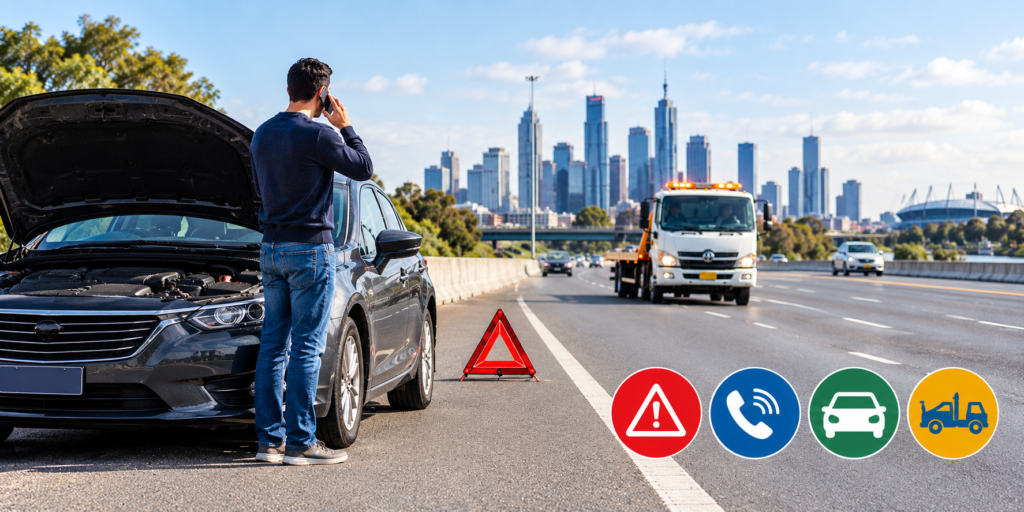
If your car dies at 100 km/h with trucks in the mirror, you don’t want an essay. You want to know what to do in the next sixty seconds. So here’s the short version, and the rest of this guide fills in everything behind it.
The short version: switch your hazard lights on straight away, take your foot off the accelerator and coast towards the left, aim for the emergency stopping lane, then get yourself and your passengers out on the side furthest from the traffic and well clear of the road. Call 000 if you’re in danger, then call roadside assistance or a tow operator. Stay put, stay aware and don’t accept help from anyone you didn’t call.
Now the detail.
What to do in the first 60 seconds
Most of the risk in a freeway breakdown comes from what you do in the first minute, not the hour that follows. A dead engine doesn’t mean a dead car; you’ve still got momentum, and you’ve still got a few seconds to make good decisions.
- Hazard lights on. Do it first, before anything else. Other drivers need to know that something has changed, and they need to know early.
- Stay calm and keep steering. If the engine cuts out, you’ll probably lose power assistance, so the steering and brakes will feel heavier. They still work. Grip the wheel firmly and keep a straight line.
- Look left, in your mirrors and ahead. Where’s the emergency lane? Is there an exit ramp coming up? Is there a gap in the traffic on your left?
- Indicate left and coast across. Move over smoothly, one lane at a time. Don’t swerve and don’t brake hard unless you have to.
- Stop as far left as you can. Ideally, you’re fully inside the emergency lane with your wheels as close to the left edge as possible.
- Handbrake on and, if it’s an auto, park. If your car rolls forward or back, even a few centimetres, it can drift into live traffic.
That sequence will keep you safer than almost any improvisation. If you remember nothing else from this page, remember to put your hazards on, move left and get out of the traffic lane.
Is it actually legal to stop on a freeway in Victoria?
This surprises plenty of people. Under the Victorian road rules, you generally can’t stop on a freeway at all. The exception is an emergency, and a genuine breakdown is exactly that. When you do need to stop, you’re meant to use the emergency stopping lane.
The RACV has been pointing out for a while that many drivers don’t realise this. In a media release on keeping to the left and not stopping on freeways, the club noted that infringements for stopping on a freeway climbed from 401 in 2019 to 978 in 2022, and that Victoria Police had issued almost 10,000 fines across a decade for rule 130 (keep left) and rule 177 (stopping on a freeway) combined. You can read the club’s reminder of Victorian road rules for the full detail.
What does that mean in practice?
- A real breakdown is allowed. You won’t be fined for pulling over because your engine has seized, a tyre has blown or a warning light says the car is about to do something nasty.
- Pulling over to check a text, have a rest, answer a call or sort out a squabble in the back seat is not an emergency. That’s where the fines come from.
- If you need a breather, take the next exit. Don’t use the emergency lane as a convenience stop.
Where to stop: the emergency lane, ramps and bays
The best place to stop on a freeway is the one that gets you furthest from moving traffic with the least drama. In order of preference, it’s usually this:
- An exit ramp or service road, if you can reach it safely. Off the freeway is always better than on it.
- The emergency stopping lane (the left-hand shoulder). It’s wide enough for most cars and designed for exactly this situation.
- A dedicated emergency stopping bay, where the freeway has them. Some managed freeway designs include bays, and they’re signposted. They’re for emergencies only.
- The right-hand shoulder or median, only if you absolutely can’t get left. It’s the least safe option because you’ll be exiting your car with fast traffic on one side and a barrier on the other.
A couple of things worth knowing about Melbourne’s freeways specifically.
Smart freeways and lane-use signs
Melbourne’s busiest freeways, including large parts of the Monash, are “managed motorways”. That means overhead gantries with electronic lane-use signs, variable speed limits and ramp signals. The state government rolled this technology out along the Monash Freeway, the Tullamarine Freeway and the M80 Ring Road to manage traffic and improve incident response, as outlined in the Victorian Government’s managed motorway announcement.
Why does this matter if your car has just died? Because on some managed sections, the emergency lane can be opened up as an extra traffic lane at busy times. If you look up and see a lane-use sign above the shoulder, take a moment to read it, because the left lane might not be the refuge you think it is. Signs can also tell you which lanes are closed ahead, which helps you work out whether it’s safe to cross over.
The Monash Freeway in particular
The Monash gets a lot of searches for a reason. It’s long, it’s busy and it carries a heavy mix of commuters, freight and weekend traffic heading to the Peninsula and Gippsland. When something fails on it, you tend to get stop-start traffic quickly, which sounds safer but isn’t. Stationary lines of cars next to a stranded vehicle are exactly how people get clipped while stepping out of a door.
If you break down on the Monash:
- Try to reach the next ramp if it’s close. Interchanges along the freeway give you a place to get fully off the carriageway.
- If you’re stuck on the shoulder, treat the traffic as unpredictable even if it’s moving slowly. A driver looking at the car ahead may not notice a person standing beside a door.
- Note the last exit you passed and the next one coming up. That’s the fastest way to explain where you are.
The same logic applies on the West Gate, CityLink, EastLink, the Princes Freeway or any other freeway in Melbourne’s network.
What if you can’t reach the emergency lane?
Sometimes the car gives you no choice. You lose power in the middle lane in heavy traffic, or the emergency lane is blocked, or you’re in a tunnel or on a bridge with no shoulder at all.
In that situation, the safest course of action is often counterintuitive: stay in the car.
Main Roads Western Australia, which runs similar smart freeways, advises drivers who can’t reach an emergency lane or bay to stay in the vehicle with their seatbelt fastened and their hazard lights on. You can see the reasoning in their smart freeway safety guidance. A stationary car in a live lane is dangerous, but a person on foot in a live lane is far more at risk. Your car is a steel cage with crumple zones and airbags, and you are not.
So, if you’re stuck in a live lane:
- Keep your seatbelt on.
- Keep your hazards on, and your headlights too if it’s dark or visibility is poor.
- Call 000 right away and tell them you’re stopped in a live lane on a freeway. This is precisely the sort of situation emergency services want to hear about.
- Don’t try to push the car, and don’t walk across lanes.
- If you can safely restart the engine and roll forward to the shoulder, do it. If not, wait for help.
This is a judgement call, and it’s one that depends on how heavy the traffic is, how far you are from safety and what’s going on around you. If a truck is bearing down on you and you have a clear path to the barrier on your left, getting out can be the right choice. But as a general rule, don’t leave a vehicle in a live lane unless it’s the only way to avoid a worse outcome.
Getting out of the car safely
Once you’re in the emergency lane and have the car secured, the next question is whether to wait inside or outside. There’s a bit of nuance to this, and it comes down to where you’ve stopped.
When to get out
On a freeway shoulder, most roadside experts will tell you to get out, but only if you can do it safely. The reason is simple. Cars do drift into emergency lanes, particularly when drivers are tired, distracted or affected by the sun. A person standing 10 metres from the car is safer than a person sitting in a car that gets hit from behind.
If you do get out:
- Use the passenger side, the one furthest from traffic. Slide across the seat if you need to.
- Get everyone out the same way, including kids. Don’t leave a passenger behind in the back seat.
- Move well clear of the road. If there’s a barrier, guardrail, fence or embankment, get behind it or beyond it. Aim to be as far away from the carriageway as you can while keeping the car in sight.
- Watch your footing. Freeway verges can be steep, uneven or full of long grass, and some are lined with drains and wire fencing.
- Take your phone, wallet and keys. Leave the rest of your gear in the boot unless you need it.
When to stay inside
Stay inside if it’s raining heavily, dark, foggy or if there’s no safe place to stand. Stay inside if the shoulder is narrow and there’s no barrier. Stay inside if you can’t leave the vehicle safely for any reason, such as a mobility issue, and make sure the people calling for you know that.
If you stay in, keep your seatbelt on and your hazards flashing. If you’re an Australian driver in a country with right-hand drivers on the left, you probably already know the old trick of sitting in the passenger seat so you’re further from the traffic; that’s a decent idea on a wide shoulder, but don’t do it if it means undoing your seatbelt while a car is approaching.
Children and pets
Kids should go first, not last. Put them well away from the road, in a spot where you can see them and where they can’t wander. Pets should be leashed or held, because dogs can bolt in a heartbeat, and a loose animal near a freeway is a disaster waiting to happen.
Who to call, and in what order
The order matters. Don’t spend twenty minutes ringing around before you tell anyone where you are.
1. Triple zero (000)
If you’re in danger, call it. Specifically:
- You’re stopped in a live lane
- There’s smoke, fire or a fuel leak
- Someone is injured or unwell
- You feel unsafe for any reason, including a driver who has stopped and is behaving strangely
The operator would much rather take a call that turns out to be unnecessary than miss one that was. If you’re unsure, call.
2. Your roadside assistance provider
If you have a membership, such as through the RACV or your insurer, ring them next. The RACV says its Emergency Roadside Assistance is available around the clock and can arrange a tow if the car can’t be fixed on the spot. Their car breakdown guide is worth a skim before you ever need it.
If you aren’t a member, or if you’d rather deal directly with a local operator, skip to the next step. If you’re not sure whether your policy covers a freeway tow, our article on what your insurance doesn’t tell you about emergency towing explains the common gaps.
3. A tow operator you’ve chosen
If you need a tow, call a company you’ve picked yourself. Cheap Tow runs emergency towing across Melbourne around the clock, and our breakdown support team can talk you through the next steps even if you’re not sure what’s wrong with the car yet.
What to tell the dispatcher
The more precise you are, the faster someone reaches you. Have these ready:
- Your exact location. Name the freeway, the direction (inbound or outbound, or the compass direction), the last exit you passed and the next one coming up. Drop a pin in your maps app and read out the street or landmark it shows.
- Which lane or shoulder you’re in. Left emergency lane, right shoulder, live lane or off the freeway entirely.
- What happened. Engine cut out, flat tyre, warning light, smoke, no fuel, something else.
- The vehicle. Make, model, colour and whether it’s a manual, automatic, electric, hybrid or four-wheel drive. That affects the kind of truck that needs to be sent. If it’s an EV or hybrid, our guides to electric vehicle towing in Melbourne and towing a Tesla, BYD or hybrid explain why.
- How many people are with you, including children, and whether anyone has a medical issue.
- Where you want the car taken. A mechanic, your home or a workshop you’ve already used.
If you can’t talk because you’re driving or your phone is mounted, use hands-free, or if you’ve already stopped, use your phone’s voice assistant. We’ve covered how that works in our post on calling a tow truck through Siri or Google Assistant.
What to expect while you wait
Freeway tows aren’t the same as suburban ones, and it helps to know why a truck might take a little longer than you’d like.
Why the truck may not be there in ten minutes
The tow operator has to get through the same traffic you were stuck in, and often the only way to reach you is via the emergency lane. Tow truck drivers in Victoria are allowed to use the emergency stopping lane to reach a breakdown or crash, but only when they can’t get there in the regular lanes because of congestion or obstructions. When they do, they must run their flashing yellow lights, stay under 40 km/h and give way to emergency vehicles. That’s laid out on the Transport Victoria page for tow truck operators driving in emergency lanes. It’s slow because it’s safe.
So a wait of 30 to 60 minutes during peak traffic isn’t a sign that something has gone wrong. If you’ve been waiting much longer than you were quoted, ring the dispatcher and ask for an update.
What to do while you wait
- Keep your hazard lights on.
- If you’re outside the car, stay behind the barrier or well clear of the shoulder.
- Keep your phone charged. Turn down the screen brightness and close apps you don’t need. If you’ve got a power bank or car charger, now’s the time.
- Stay visible. If it’s dark, a torch or hi-vis vest helps. Don’t place a warning triangle on a busy freeway unless you can do it safely and the shoulder is wide; on a fast road, walking back along the verge to put a triangle down can put you at more risk than the car does.
- Tell someone you trust where you are and what’s happening.
Don’t take help from strangers
Unfortunately, a stationary car on a freeway attracts attention from people who aren’t on your side. Unsolicited tow operators have been known to turn up at breakdowns and crashes, quote inflated prices and pressure drivers into signing paperwork on the spot.
A few rules of thumb:
- If you didn’t call them, don’t use them.
- Ask for the operator’s business name, a quote and a vehicle destination before they hook up anything.
- Never sign a blank or incomplete form.
- Be wary of anyone who won’t tell you where your car is being taken.
We’ve written a longer guide on towing scams every driver should know about, and another on how to choose a tow truck company in Melbourne. Both are worth a read before you’re standing on a verge with your hazards flashing.
Common freeway breakdown situations
Not all breakdowns look the same. Here’s how the first few minutes can differ depending on what’s gone wrong.
A sudden loss of power
The engine cuts out and the dashboard lights up. Keep steering, hazards on, and coast left. Once you’re stopped, try to restart the engine once. If it doesn’t start, don’t keep cranking it, because you may flatten the battery or make the problem worse. For a deeper look at what tends to cause this, our post on car problems that can cause sudden breakdowns is a good place to start.
A flat or blown tyre
A blowout feels dramatic, but the golden rule is not to slam the brakes. Hold the wheel firmly, ease off the accelerator and let the car slow down gradually while you steer towards the left. Don’t try to change the tyre on a freeway shoulder unless you’re certain it’s safe. Most of the time it isn’t, and the safest option is to wait for help. A space-saver spare also has speed and distance limits that don’t suit a freeway anyway.
Running out of fuel
It happens more than anyone likes to admit, particularly on long freeway stretches where the next servo is further than you thought. Treat it as a breakdown: hazards on, coast left and call for help. Don’t try to walk to a petrol station along the freeway. Our post on emergency fuel help covers your options.
Overheating or smoke
If you see steam, smell something burning or notice smoke coming from under the bonnet, move left and stop as soon as you can, then get everyone well clear of the vehicle. Don’t open the bonnet. Hot coolant can spray out, and a fire can flare up quickly when fresh air reaches it. If you see flames, move away and call 000.
Electric and hybrid vehicles
EVs and hybrids don’t normally “stall” in the same way petrol cars do, but they can lose drive power, shut down in a fault or run out of charge. Some can’t be towed with their drive wheels on the ground without risking damage to the motor or battery system. If you drive one, tell the dispatcher at the start of the call so they can send the right equipment.
Bad weather or low visibility
Rain, fog and night-time driving all make freeway breakdowns more dangerous. If you’ve stopped in poor visibility, stay in your car with your seatbelt on unless you can clearly see a safe place to stand. We’ve covered the specifics of after-dark situations in our guide to emergency towing at night.
Mistakes that make a bad situation worse
A few things come up again and again when we talk to drivers after a freeway breakdown:
- Leaving the car in a live lane and walking away to find a phone signal.
- Standing between the car and the traffic, often with the driver’s door open to the lane.
- Trying to fix the car on the shoulder. Jacks and traffic don’t mix.
- Waving down passing cars for help. Not only is it dangerous, but you also can’t be sure who stops.
- Accepting the first tow offer without checking the operator or the price.
- Sitting with the engine running and the car in gear, which is a quick way to creep into the lane or damage a failing transmission.
- Forgetting your passengers. Kids and pets get missed in the rush more often than you’d expect.
- Assuming you’ll get a signal. Most of Melbourne has good coverage, but tunnels, cuttings and some outer stretches don’t.
Build a freeway-ready kit
You don’t need a boot full of gear. A small kit that lives in the car all year is enough to make a long wait a lot more comfortable and a lot safer.
- A high-visibility vest for each adult, or at least one for the driver
- A torch with fresh batteries (a headlamp is even better)
- A phone charger or power bank
- A bottle of water and a few snacks
- A basic first-aid kit
- A warm layer or blanket
- A reflective warning triangle
- A printed copy of your roadside assistance number and your insurer’s claims line
- Tyre sealant or a compact compressor if your car doesn’t have a spare
The RACV also publishes a handy list of items for a roadside emergency safety kit if you want to go further.
And remember that the best breakdown is the one that never happens. Before a long freeway run, check your tyre pressures, oil, coolant and fuel level, and take any warning light seriously. Our article on six things to know before calling a towing service in Melbourne is also a useful read to have in your back pocket.
After the tow
Once the car is on its way and you’re somewhere safe, take a breath. A freeway breakdown is stressful even when everything goes right. A few things to do afterwards:
- Check the quote or invoice before you sign anything.
- Ask where the car is going and when you can collect it.
- Take photos of the car and where it was stopped, in case you need them for an insurance claim.
- Contact your insurer, particularly if there was any damage or if the breakdown was caused by something that might be covered.
We’ve put together a post-towing checklist that walks you through what to do once your vehicle has been collected. If you’re curious about pricing, our Melbourne towing cost guide breaks down what to expect.
A quick freeway breakdown checklist
Screenshot this or save it to your phone.
- Hazard lights on
- Indicate left and coast to the emergency lane or next exit
- Stop as far left as possible, handbrake on
- Danger? Call 000 first
- Exit through the passenger side if it’s safe, and move well clear
- Call roadside assistance or a tow operator you’ve chosen
- Give a precise location: freeway, direction, last exit, next exit
- Stay put and stay alert
- Don’t accept help from operators you didn’t call
- Check the quote and destination before the tow begins
Frequently asked questions
What should I do if I break down on a freeway in Victoria?
Turn on your hazard lights, move left and stop in the emergency lane or take the next exit if you can reach it. Get out on the side furthest from traffic if it’s safe, move well clear of the road and call for help. Ring 000 if you’re in danger, then your roadside assistance provider or a tow operator you trust.
Is it illegal to stop on a freeway in Melbourne?
Generally, yes, unless it’s an emergency. A mechanical breakdown counts as an emergency, but you should stop in the emergency lane where there is one. Stopping for non-emergency reasons can lead to a fine.
Should I stay in my car or get out if I break down on the freeway?
It depends on where you are. If you’ve reached the emergency lane and it’s safe to leave the vehicle, get out via the passenger side and move well away from the road. If you’re stuck in a live lane, can’t reach a shoulder or visibility is poor, stay inside with your seatbelt on and hazards flashing, and call 000.
What is the safest place to stop on a freeway?
An exit ramp or service road is best, followed by the left-hand emergency lane or a signposted emergency bay. The right-hand shoulder is the least safe option and should only be used if you can’t get left.
Who do I call first when I break down on a freeway?
Call 000 first if you’re in danger, there’s a fire or someone is hurt. Otherwise, ring your roadside assistance provider or a tow company you’ve chosen. Be ready with your location, the direction of travel, the last exit you passed and what’s wrong with the car.
How long does a tow truck take on a Melbourne freeway?
It varies with traffic, time of day and where you are. Peak-hour freeways can slow even a fast response. Tow trucks can use the emergency lane to reach you, but they’re limited to 40 km/h while doing so. If the wait is longer than quoted, call the dispatcher for an update.
Can I change a flat tyre on the freeway shoulder?
It’s not recommended. The shoulder is close to fast traffic, the ground can be uneven and spare wheels often have speed limits that don’t suit a freeway. Waiting for help is the safer choice.
Can I accept help from a tow truck I didn’t call?
We’d advise against it. Unsolicited operators sometimes turn up at breakdowns and pressure drivers into expensive, rushed decisions. Stick with a provider you’ve contacted yourself, and ask for the price and the destination before anything is hooked up.
What if I break down on the Monash Freeway during peak hour?
The steps are the same: hazards on, move left, stop in the emergency lane, get clear if it’s safe and call for help. Peak-hour traffic can be slow and bunched, so stay alert even if cars seem to be crawling, and check overhead signs in case the emergency lane is in use as a traffic lane.
Does my insurance cover a freeway tow?
Some policies include roadside assistance or a set number of tows, but limits vary. Check your policy for the distance covered, the call-out conditions and any exclusions before you need it.
Need a hand on a Melbourne freeway?
Nobody plans for a breakdown, and nobody enjoys one. But a clear head and a few simple steps make a world of difference to how it plays out.
If you’re stuck right now or you’d like to know who to call before it happens, Cheap Tow provides emergency towing across Melbourne at any hour, and our breakdown support team can help you work out the best next step. Keep the number saved, keep a small kit in the boot and keep calm. You’ll be fine.
This guide is general information only and isn’t legal advice. Road rules and policies change, so check with Transport Victoria, the RACV or your insurer for the latest details.

