
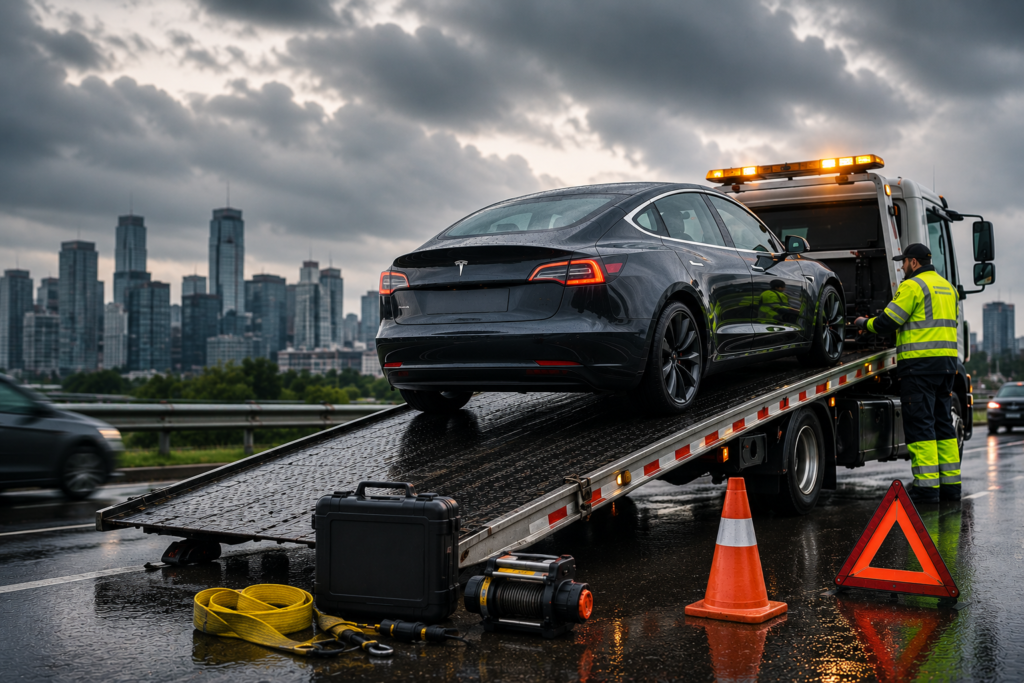
You are driving your Tesla Model Y through Cremorne on your way to a morning meeting. Or maybe you are in your BYD Atto 3, stuck on the Monash during peak hour with a warning light flashing on the dashboard. Perhaps your Toyota RAV4 Hybrid has unexpectedly stalled on the Western Ring Road.
You call a tow truck. The driver arrives, hooks up your vehicle the same way he would handle a 2009 Holden Commodore, and drags it away. Job done, right?
Wrong. In each of those scenarios, that standard tow could cause thousands of dollars in damage to your drivetrain, battery pack, or electric motor damage that your warranty may not cover and that your insurer may contest if the wrong towing method was used.
Electric vehicles and hybrids are now everywhere on Melbourne roads. In May 2026, EVs accounted for more than 20 percent of all new light vehicle sales in Australia. Tesla, BYD, Toyota hybrids, and a growing list of Chinese-brand EVs are appearing in driveways right across Melbourne’s suburbs, from Toorak and Brighton to Craigieburn and Werribee. Yet a large number of tow truck operators across Victoria are still not fully trained or equipped for these vehicles.
This guide explains exactly why EVs and hybrids need to be towed differently, what the specific requirements are for Tesla, BYD, and Toyota hybrid models, what can go wrong when a standard tow is used, and what you need to do the moment your vehicle breaks down on a Victorian road.
Why Electric Vehicles Cannot Be Towed Like Petrol Cars
Before getting into brand-specific guidance, it is important to understand the core reason that EV and hybrid towing is different from towing a conventional petrol or diesel vehicle.
The Regenerative Braking Problem
Every EV and hybrid sold in Australia including every Tesla, BYD model, and Toyota hybrid uses a system called regenerative braking. This is the technology that captures energy during deceleration and feeds it back into the battery, which is a big part of why these vehicles are so efficient.
The critical issue is this: regenerative braking does not switch off just because the vehicle is powered down. When the wheels of an EV turn even if the car is completely off and being dragged by a tow truck the electric motors spin, the regenerative system activates, and electricity is sent back into the battery pack in an uncontrolled and potentially damaging way.
This uncontrolled electrical generation can:
- Overcharge or overheat the battery cells
- Cause premature battery degradation
- Damage the electric motor assembly and powertrain components
- Trigger electrical faults that are expensive to diagnose and repair
For all-wheel-drive EV and hybrid models, both the front and rear axles have electric motors, which means all four wheels contribute to this problem simultaneously.
The Underbody Clearance Problem
EV battery packs are mounted along the underside of the vehicle to keep the centre of gravity low. This means EVs typically have less ground clearance than equivalent petrol vehicles. Standard tow hooks, chains, and wheel-lift equipment can make direct contact with the battery frame during loading, causing structural damage that is both dangerous and expensive.
The Flat Towing Problem
Flat towing also called dinghy towing is when all four wheels remain on the ground while the vehicle is pulled by another vehicle or a tow truck. This method is not recommended for any EV and is specifically prohibited by Tesla, BYD, and Toyota for their hybrid and electric models. Even a short-distance flat tow can result in damaged motor components, a compromised drivetrain, and a voided warranty.
Tesla Breakdown in Melbourne: What You Must Know
Tesla is the most common premium EV on Melbourne roads, and it has some of the most specific towing requirements of any vehicle currently sold in Australia.
The Only Acceptable Towing Method for a Tesla
Tesla’s owner’s manual is unambiguous: flatbed towing is the only recommended method for transporting a Tesla. This applies to all models the Model 3, Model Y, Model S, and Model X.
A flatbed tow truck (also known as a tilt-tray in Victoria) lifts all four wheels completely off the ground and transports the vehicle on a flat platform. This eliminates any wheel rotation, prevents regenerative braking from activating, and protects the battery pack from underbody contact.
If a flatbed truck is genuinely unavailable in an emergency, a tow dolly can be used as a last resort. Tow dollies lift the front wheels while the rear wheels rest on a dolly but this must only be used for very short distances at very low speeds.
What you should never do is allow a standard wheel-lift tow to be performed on your Tesla with all four wheels on the ground. This is one of the most common and costly mistakes Melbourne EV owners make when they call an unprepared tow operator.
Tesla Transport Mode: What It Does and How to Activate It
Newer Tesla models feature a function called Transport Mode. This mode disengages the parking brake and prevents the vehicle from automatically shifting into Park when you exit the car, which makes it far easier for a flatbed operator to safely load the vehicle onto the truck.
To activate Transport Mode:
- Ensure the vehicle has at least 5 percent battery charge
- Go to Controls on the touchscreen
- Select Service
- Select Towing
If your Tesla has completely lost power, you or the tow operator may need to disconnect the 12-volt auxiliary battery using a 10mm wrench (usually located in the frunk or rear compartment depending on the model) to release the electronic parking brake manually. This is an unusual step for any vehicle to require in a basic roadside situation, so it is worth knowing about before a breakdown happens.
What to Tell the Tow Operator
When you call for a tow, tell the dispatcher the following before they send anyone:
- “My vehicle is a Tesla and requires a flatbed or tilt-tray truck.”
- “A wheel-lift or standard tow cannot be used.”
- “The tow operator should be familiar with Tesla towing procedures.”
If the operator confirms they are sending a wheel-lift truck, do not allow them to tow your vehicle. Call a different operator or contact Cheap Tow’s 24/7 emergency line for a flatbed-equipped crew that is familiar with EV towing requirements in Victoria.
Tesla Model-Specific Notes
Tesla Model 3: Must be flatbed towed or have front wheels placed on a dolly. The Model 3 is not designed for flat towing under any circumstances.
Tesla Model Y: Requires flatbed towing. Its slightly higher ground clearance compared to the Model 3 can make loading marginally easier, but the same rules apply strictly.
Tesla Model S and Model X: Both require flatbed towing with special attention if the vehicle is equipped with air suspension. The suspension should be set to its highest position during loading to protect the underbody.
BYD Breakdown in Melbourne: What You Must Know
BYD has rapidly established itself as one of the fastest-growing EV brands in Australia, with models including the Atto 3, Dolphin, Seal, Sealion 6, and the plug-in hybrid Shark 6 now appearing across Melbourne streets and Victorian highways.
BYD EV Models: Same Flatbed Rule Applies
BYD’s pure electric vehicles the Atto 3, Dolphin, and Seal follow the same fundamental towing rules as any other EV. Flatbed towing is the required method. The wheels must be completely off the ground to prevent regenerative braking activation and drivetrain damage.
BYD’s own roadside assistance program, which is included with every BYD vehicle for the duration of the 6-year vehicle warranty, will arrange a flatbed tow to the nearest charger or authorised dealer in the event of a breakdown. In some metro Melbourne areas, mobile charging assistance may also be available as an alternative to towing if the vehicle has simply run out of charge.
If you are arranging your own tow rather than going through BYD’s roadside assistance, make sure you specifically request a flatbed truck and communicate to the operator that your vehicle is an EV.
The BYD Shark 6: A Unique Case
The BYD Shark 6 is a plug-in hybrid ute that has taken the Australian market by storm, combining a 1.5-litre turbocharged petrol engine with front and rear electric motors and a 29.5kWh LFP battery. With a braked towing capacity of 2,500 kilograms on the standard model and 3,500 kilograms on the Performance variant, it is one of the most capable vehicles in its class.
However, because the Shark 6 uses an electric motor on each axle with no mechanical connection between front and rear, the standard EV towing rules apply here as well. If the Shark 6 needs to be towed due to a mechanical failure or breakdown, a flatbed is the correct method.
There is one additional consideration for the Shark 6 specifically: the tow operator should always be informed that the vehicle contains a high-voltage battery pack, as this affects how the vehicle is handled during loading and transport.
What to Tell the BYD Tow Operator
- Confirm the specific BYD model you are driving
- State that it is an EV or PHEV and requires flatbed towing
- If BYD roadside assistance is not responding within an acceptable timeframe, call a Victoria-based towing company with EV experience such as Cheap Tow
Toyota Hybrid Breakdown in Melbourne: What You Must Know
Toyota hybrids including the Prius, Corolla Hybrid, Camry Hybrid, RAV4 Hybrid, and RAV4 Prime are among the most popular vehicles on Melbourne roads. Many owners assume that because these vehicles have a conventional petrol engine as well, they can be towed exactly like any other car. This assumption is incorrect.
The Toyota Hybrid Towing Challenge
Toyota hybrids use a system called the eCVT (Electronic Continuously Variable Transmission), which involves electric motors specifically MG1 and MG2 being permanently connected to the planetary gear set. When the front wheels of a Toyota hybrid turn during towing, MG2 spins. When the rear wheels turn (in AWD hybrid models like the RAV4 Hybrid), the rear electric motor also spins.
This creates the same regenerative braking risk that applies to full EVs, with potential for electrical system stress and component wear.
For AWD Toyota hybrid models, flatbed towing is the standard industry recommendation. Communicating to the tow operator that your vehicle is an all-wheel-drive hybrid is often all that is needed to trigger the correct response, since AWD vehicles in general should be towed on a flatbed to prevent drivetrain damage.
For front-wheel-drive Toyota hybrids like the Prius (in standard configuration), lifting the rear wheels while placing the front wheels on a dolly may be acceptable for short distances, but flatbed towing remains the safest and most recommended option.
The 12-Volt Battery Consideration
One issue specific to Toyota hybrids is the 12-volt auxiliary battery. If this battery is flat, the vehicle cannot be placed in neutral via normal methods, which can complicate loading onto a flatbed. An experienced tow operator with hybrid knowledge will know how to handle this correctly. An unprepared operator may attempt to force the vehicle into a position it cannot safely occupy, causing damage.
Toyota RAV4 Hybrid: Victoria’s Most Common Hybrid
The RAV4 Hybrid is consistently one of the top-selling vehicles in Victoria. If you own one and it breaks down, here is what to do:
- Pull over safely and activate your hazard lights
- Call your roadside assistance provider or Cheap Tow’s 24/7 line
- Tell the operator your vehicle is an AWD hybrid and request a flatbed or tilt-tray truck
- Do not accept a wheel-lift tow with any wheels dragging on the ground
The EV Towing Comparison Table
| Vehicle Type | Recommended Tow Method | Flat Tow Allowed? | Special Notes |
|---|---|---|---|
| Tesla Model 3 | Flatbed only | No | Activate Transport Mode if possible |
| Tesla Model Y | Flatbed only | No | Raise air suspension if equipped |
| Tesla Model S / X | Flatbed only | No | Air suspension to highest setting |
| BYD Atto 3 / Dolphin / Seal | Flatbed only | No | BYD roadside assistance included (6 years) |
| BYD Shark 6 (PHEV) | Flatbed only | No | Inform operator of high-voltage battery |
| Toyota Prius (FWD) | Flatbed preferred | Short distance only | Rear wheels on dolly acceptable as last resort |
| Toyota RAV4 Hybrid (AWD) | Flatbed only | No | Always communicate AWD status |
| Toyota Corolla / Camry Hybrid | Flatbed preferred | Limited only | Consult owner’s manual for specific guidance |
What Happens If the Wrong Tow Method Is Used?
The consequences of an incorrect tow on an EV or hybrid are not minor. Depending on the vehicle and the nature of the towing, you could be looking at:
- Battery pack damage: Uncontrolled electrical charging during towing can degrade battery cells, reduce overall range, and in serious cases cause thermal issues. Battery replacements on Tesla and BYD vehicles are among the most expensive repairs in the automotive industry.
- Electric motor damage: Spinning the motor without lubrication or cooling, which is designed to operate within normal driving parameters, can cause bearing wear and electrical winding damage.
- Drivetrain damage: For AWD EVs and hybrids, improper towing with wheels on the ground can stress the electronic differential systems and associated components.
- Warranty voidance: If a manufacturer can demonstrate that incorrect towing caused or contributed to a fault, they may refuse to cover the repair under warranty. This is a real and documented risk.
- Insurance complications: Some insurers will contest claims where damage was caused by a third party using an incorrect towing method, leaving you in a dispute that takes months to resolve.
For more information about protecting your vehicle after a breakdown, read our complete post-towing checklist.
What to Do the Moment Your EV or Hybrid Breaks Down in Victoria
Step 1: Get Safe First
Pull as far off the road as possible, activate your hazard lights, and if you are on a freeway or high-speed road, exit the vehicle and stand well away from traffic behind a barrier if one is available. According to Transport Victoria’s road safety guidelines, this is the most critical immediate action in any breakdown situation.
Step 2: Do Not Attempt to Push or Roll the Vehicle
Unlike a petrol car that can be safely pushed in neutral, rolling an EV or hybrid along the road activates the drivetrain. Do not allow anyone to push your vehicle significant distances.
Step 3: Call a Tow Operator with EV Experience
Call a towing company that specifically handles EVs and hybrids with the correct equipment. When you call, state:
- The make and model of your vehicle
- That it is an EV, PHEV, or hybrid
- That you require a flatbed or tilt-tray truck
- Your exact location or the nearest landmark or freeway exit
Cheap Tow’s 24/7 emergency line is available around the clock across Melbourne and Victoria with flatbed-equipped trucks suitable for EV and hybrid towing.
Step 4: Inform the Driver When They Arrive
Even if the dispatcher has been informed, confirm directly with the arriving driver that your vehicle is an EV or hybrid and remind them of the flatbed-only requirement. Do not let the driver proceed with loading until you are satisfied with the method being used.
Step 5: Document Everything
Take photos of your vehicle’s position, any visible damage, and the tow truck before and after loading. This protects you in any subsequent insurance or warranty claim, and gives you a clear record of the vehicle’s condition before and after transport.
Why Many Standard Tow Operators in Victoria Are Not Equipped for EVs
The rapid growth of EV ownership in Victoria has outpaced the rate at which the towing industry has updated its equipment and training. Many smaller operators are still using traditional wheel-lift trucks that are entirely unsuitable for EV towing. Some may be unaware of the specific towing requirements for individual EV models.
This is not a criticism of the industry as a whole, it is simply a reflection of how quickly the vehicle landscape has changed. In 2020, EVs made up less than 1 percent of new car sales in Australia. By mid-2026, that figure had risen dramatically, and the Victoria towing industry is actively catching up.
The safest approach as an EV or hybrid owner is to proactively know your vehicle’s towing requirements before a breakdown happens, and to have the number of an EV-experienced towing operator saved in your phone. Waiting until you are stranded on the Hume Highway to research the correct tow method is not the moment you want to be doing that research.
Conclusion: Know Before You Break Down
The growth of EVs and hybrids on Melbourne roads is one of the most significant shifts in Australian motoring in decades. Tesla, BYD, and Toyota hybrids are now everyday vehicles across Victoria — but their towing requirements are anything but ordinary.
The core message of this guide is simple: flatbed towing is the only safe method for EVs, PHEVs, and most AWD hybrids. A standard wheel-lift tow on one of these vehicles can cause battery damage, motor damage, drivetrain problems, voided warranties, and contested insurance claims.
The best thing you can do right now, before any breakdown happens, is save the number of an EV-experienced 24/7 towing company in your phone. If you drive a Tesla, BYD, or Toyota hybrid anywhere in Melbourne or Victoria, Cheap Tow is available around the clock with the right equipment and the right knowledge to transport your vehicle safely.
Need an EV or hybrid tow right now? Call Cheap Tow 24/7: 0470 320 481

