Can You Tow a Car With a Rope or Strap in Victoria? The Rules, the Risks and When It’s Smarter to Call a Tow Truck
Quick answer
Yes, you can tow a car with a rope or strap in Victoria, but only if it is safe and either the towing driver can control the towed car’s movement, or the towed car’s brakes and steering work and a person licensed to drive it is in the driver’s seat controlling them. Under rule 295 of the Road Safety Road Rules 2017, the gap between the two vehicles must be no more than 4 metres (2.5 metres if either is a motorbike), and a towline longer than 2 metres must carry a white or brightly coloured flag at its midpoint. Each rule carries a maximum penalty of 3 penalty units.
This guide is general information about Victorian law and road rules, current at the time of writing. It is not legal advice. Check the linked official sources or get advice for your situation.
Key takeaways
- ✓You can tow a car with a rope or strap in Victoria, but only if it’s safe and the towed car can be controlled.
- ✓The gap between the vehicles must be no more than 4 metres (2.5 metres if either is a motorbike).
- ✓A towline longer than 2 metres needs a white or brightly coloured flag at its midpoint.
- ✓Each rule carries a maximum penalty of 3 penalty units.
- ✓WorkSafe warns that flat towing an EV or hybrid with its driven wheels turning can create heat and fire. For any car, including AWDs, check the owner’s manual before towing.
Most of us have seen it, or done it. A mate’s car won’t start, someone has a strap in the boot, and the plan is to tow it “just around the corner” to a driveway or a mechanic. It feels like the kind of thing people have always done, and in Victoria it isn’t automatically illegal. But the road rules set out specific conditions if you tow a car with a rope, strap or chain, and the practical risks are bigger than most people expect.
This guide explains what the Victorian road rules actually say, what the numbers mean, what tends to go wrong in real life, and how to decide when a rope tow is reasonable and when it is time to call a tow truck.
The two road rules that apply
The Road Safety Road Rules 2017 deal with towing in Part 18, “Miscellaneous road rules”. Two rules matter here.
Rule 294: keeping control of a towed vehicle
Rule 294(1) says the driver of a motor vehicle must not tow another motor vehicle unless:
- either the driver can control the movement of the towed vehicle, or the brakes and steering of the towed vehicle are in working order and a person who is licensed to drive the towed vehicle is sitting in its driver’s seat and in control of its brakes and steering, and
- it is safe to tow the towed vehicle.
With a rope or strap, the towing driver cannot control the towed car’s movement. A flexible line can pull, but it can’t stop the towed car or steer it. So in practice, a rope tow is only lawful if someone licensed to drive the towed car is behind its wheel, with working brakes and steering.
Rule 295: towing with a towline
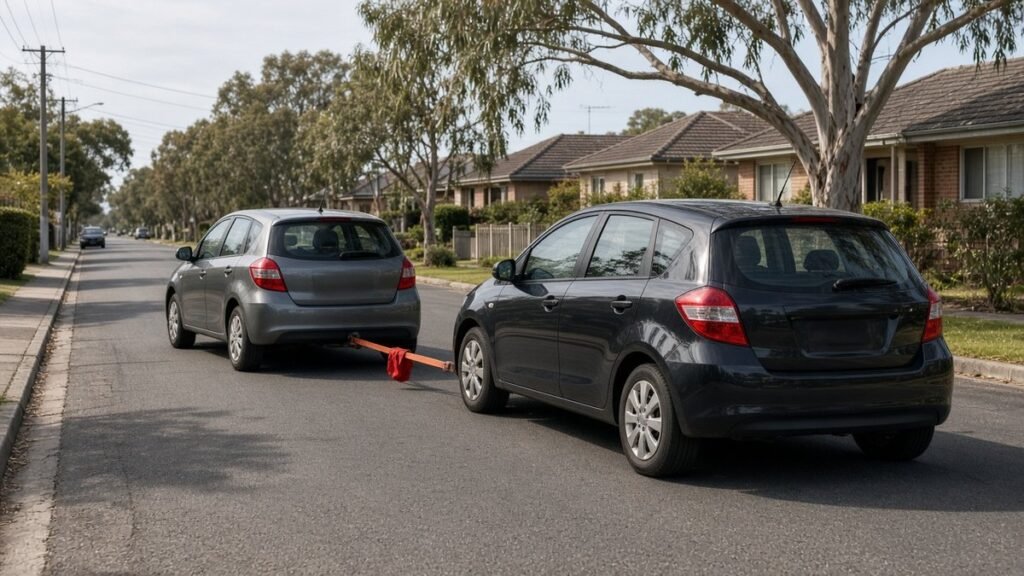
Rule 295 applies when a motor vehicle tows another vehicle using a chain, rope, fabric, strap or wire, which the rule calls the towline. The driver must:
- keep a distance of not more than 4 metres between the vehicles if neither is a motorbike
- keep a distance of not more than 2.5 metres if at least one is a motorbike
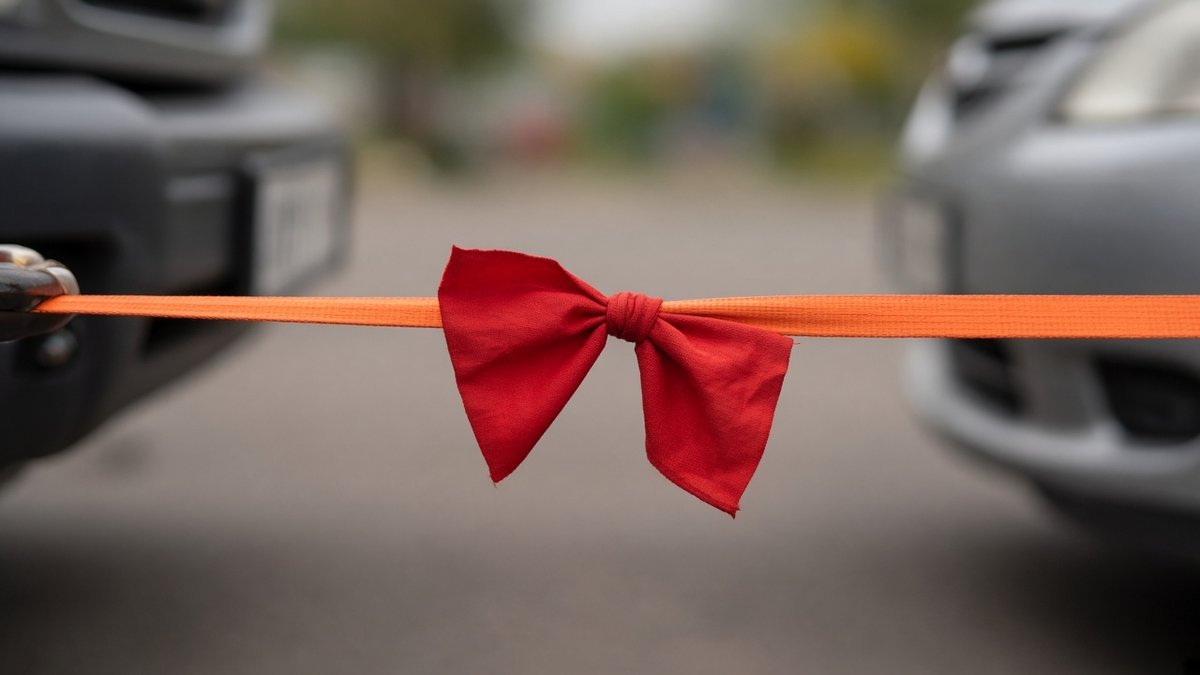
- if the towline is longer than 2 metres, attach a white or brightly coloured flag, piece of cloth or similar material midway along it
The warning material must be substantially square or rectangular with two adjacent sides at least 300 millimetres long, and be visible for at least 100 metres from either side.
| Requirement | Rule | Detail |
|---|---|---|
| Control of the towed car | 294(1)(a) | Towing driver controls it, or a licensed driver is in the towed car controlling working brakes and steering |
| Safety | 294(1)(b) | It must be safe to tow the vehicle |
| Maximum gap, cars | 295(2) | Not over 4 m between vehicles |
| Maximum gap, motorbikes | 295(3) | Not over 2.5 m if either vehicle is a motorbike |
| Warning flag | 295(4) and (5) | Needed if the towline is over 2 m; at least 300 mm on two adjacent sides, attached midway, visible from 100 m |
| Maximum penalty | 294 and 295 | 3 penalty units each ($627.30 at the 2026-27 value) |
The penalty figure is the court maximum based on the 2026-27 penalty unit value of $209.10. Separate offences, such as careless or dangerous driving, may apply if a tow goes wrong.
What the rules mean in practice
Someone has to drive the broken-down car
Rule 294 requires the person in the towed car to be licensed to drive it. A passenger without a licence doesn’t meet that description. And the brakes and steering have to be in working order, which rules out a car with a seized wheel, a broken steering component or failed brakes.
“Working” brakes and steering may feel very different
This is the part that surprises people. Many modern cars have power-assisted brakes and steering. If the car can’t be switched on, that assistance may not be working, and the car can feel quite different to steer and stop from what the driver is used to. Expect that before you set off, keep speeds low, and check the owner’s manual for what it says about towing with the engine off.
If the towed car can be switched on (for example, the problem is a fuel issue rather than a dead battery), check the owner’s manual for its towing procedure. Many manuals explain whether the ignition should be on, what gear to select and any speed or distance limits for towing.
Four metres is closer than it looks
A 4-metre maximum gap means the towed car is less than one car length behind. Any sudden braking by the front car leaves the rear driver very little time to react. Keeping the strap taut, avoiding snatching it and travelling slowly are what make the arrangement manageable.
Cars that shouldn’t be towed with wheels on the ground
Being lawful under rule 295 doesn’t make a rope tow suitable for every car. Some vehicles can be damaged by being towed with their driven wheels turning.
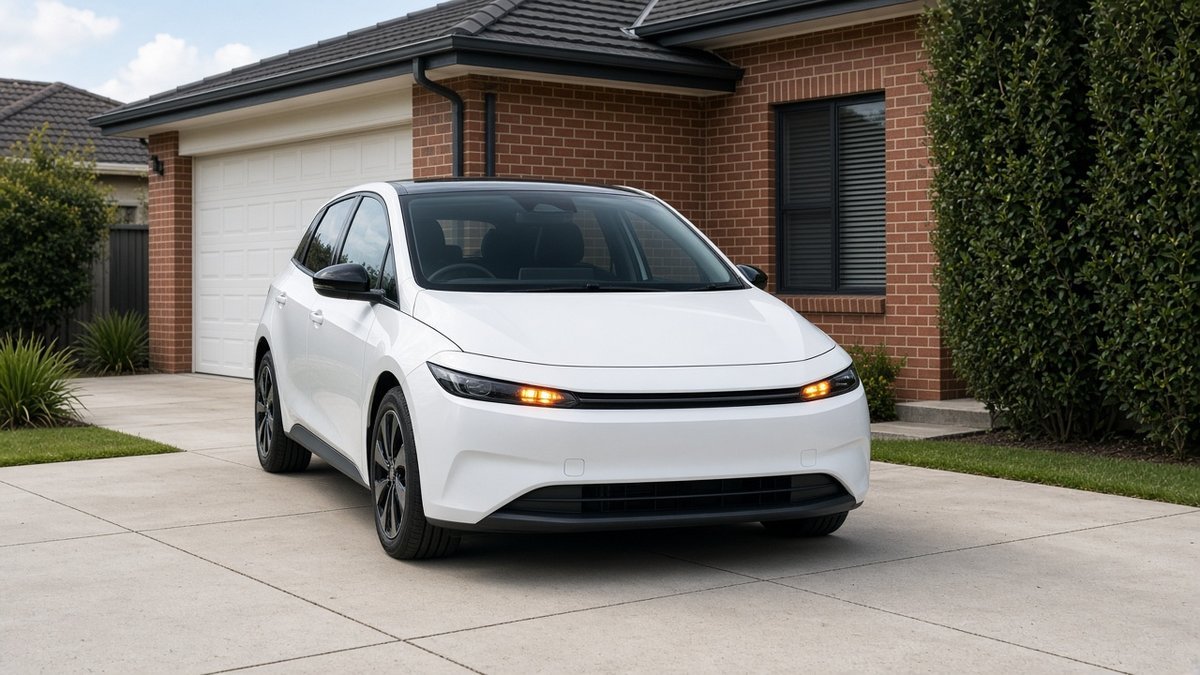
- Electric vehicles and hybrids. WorkSafe Victoria warns that if a hybrid or electric vehicle is moved by flat towing, allowing its driven wheels to turn, this may generate an electrical charge that can create heat and fire, and that many manufacturers identify the risk in their manuals. Our guides to EV towing in Melbourne and towing a Tesla, BYD or hybrid cover this in detail.
- All-wheel-drive and four-wheel-drive vehicles. Towing with some wheels on the ground can affect the drivetrain, so check what the owner’s manual allows before you tow.
- Automatic transmissions. Towing limits vary between models. The owner’s manual is the authority for your car.
When the manual says flatbed only, a rope tow isn’t a shortcut. It is a way to turn one repair into two.
Common mistakes with rope and strap towing
- Using a recovery strap as a tow strap. Snatch or recovery straps used in four-wheel driving are designed to stretch. That elasticity can cause the towed car to surge forward.
- Attaching to the wrong point. Bumpers, suspension arms and tie-down hooks are not tow points. Use the manufacturer’s towing eye or recovery points.
- Leaving the steering locked. The towed car needs to be steerable, which may mean the key or ignition must be in the correct position.
- Forgetting the flag on a long strap.
- Exceeding the 4-metre gap because the only rope available is long.
- Towing a heavier car with a lighter one. Rule 294 requires the tow to be safe. Check the towing vehicle’s capacity and use common sense.
- No communication plan. The two drivers need agreed signals, or a phone on hands-free, for “slow down” and “stop”.
If you decide to tow a car with a rope: a checklist
If you have checked the owner’s manuals and are satisfied the tow is safe and lawful, these steps reduce the risk.
- Confirm the person steering the towed car holds a licence to drive it.
- Check that its brakes and steering work and the steering lock is released.
- Use a purpose-made tow strap or rope rated for the job, attached to proper towing points on both cars.
- Keep the gap at 4 metres or less, and flag the line if it is over 2 metres.
- Turn on hazard lights on both cars.
- Agree on the route in advance, choosing quiet streets and avoiding hills, freeways and busy intersections.
- Drive slowly and smoothly, signal early and brake gently so the towed driver can match you.
- Stop and reassess if anything feels wrong.
Three common scenarios, worked through
These are illustrative examples, not real cases, to show how the rules and the practical risks combine.
A manual hatchback with a flat battery, 300 metres from home
A licensed friend can sit in the hatchback. The ignition can be turned to release the steering lock, the brakes work and the route is two quiet residential streets. A proper tow strap, attached to the towing eye, keeps the gap under 4 metres. This is close to the best case for a rope tow, although a jump start might solve the problem without towing at all.
An automatic SUV that died on a main road, needing to get to a mechanic five kilometres away
The route includes traffic lights, a hill and a busy arterial road. The owner’s manual may restrict towing the vehicle with its wheels on the ground, and an AWD system could add drivetrain risk. Even if a licensed driver is available, it is hard to argue this tow is “safe” in the sense rule 294 requires. A tilt tray is the sensible option.
A car with a collapsed wheel after hitting a kerb
The steering isn’t in working order and the damaged wheel can’t roll properly. Rule 294’s condition about working brakes and steering isn’t met, so a rope tow isn’t an option. The car needs to be lifted or carried.
Before you tow at all: is towing the real answer?
Many breakdowns don’t need a tow. A flat battery, an empty tank or a flat tyre can often be fixed on the spot. Our guides to hidden car problems that cause sudden breakdowns and running out of fuel may help you rule out the simple causes first.
When it’s smarter to call a tow truck
In our view, a rope tow only makes sense for short, slow, low-traffic moves with a vehicle that is designed to be towed that way. Call a tow truck if:
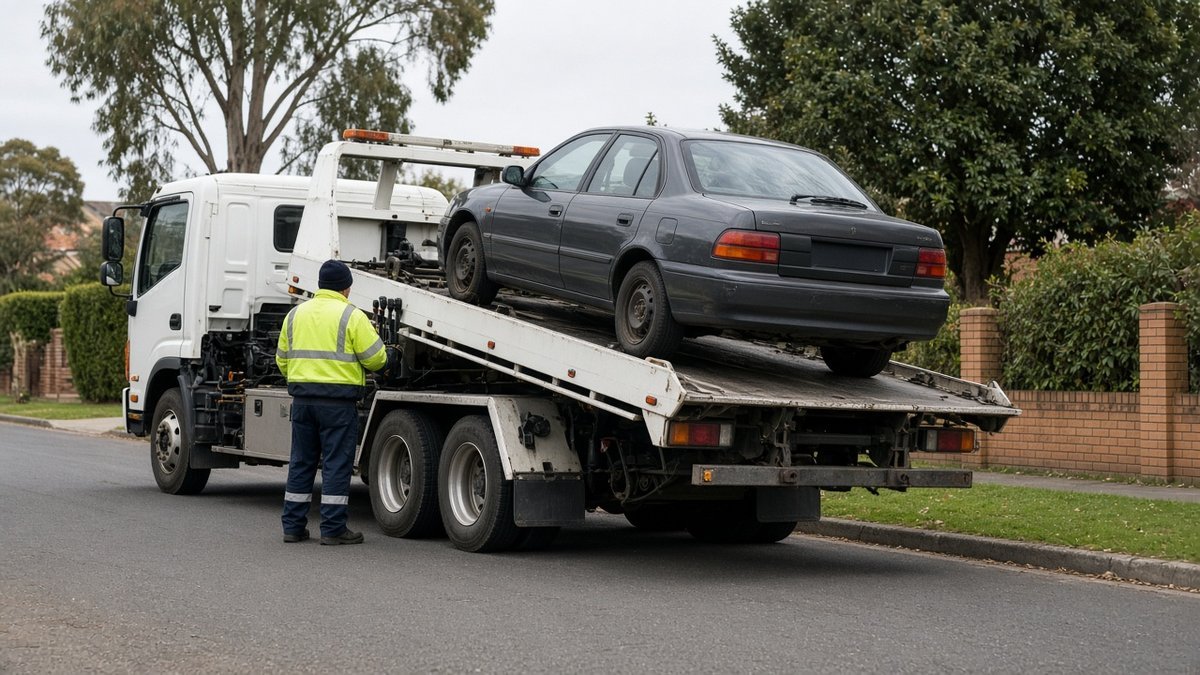
- the brakes or steering don’t work, or a wheel is damaged
- there is no licensed driver available to steer the towed car
- the car is an EV, hybrid, all-wheel drive or an automatic the manual says shouldn’t be towed with wheels down
- the route involves a freeway, busy arterial road, hills or a long distance
- the car has been in a crash
- you are not sure what is wrong with it
If you’re stranded on a high-speed road, our article on breaking down on a Melbourne freeway explains what to do while you wait. And if cost is the concern, our Melbourne towing cost guide sets out what drives the price.
Rope towing versus other options
| Method | Who controls the towed car | Best suited to | Main risks |
|---|---|---|---|
| Rope or strap | Licensed driver in the towed car | Short, slow moves of cars designed to be towed with wheels down | Controlling the towed car, close gap, drivetrain damage |
| Rigid tow bar or A-frame | The towing vehicle | Regular, planned towing with approved equipment | Equipment and compliance requirements |
| Tilt tray or flatbed | Not applicable; car is carried | Damaged cars, EVs, AWDs, long distances, unknown faults | Cost and waiting time |
The bottom line
You can tow a car with a rope or strap in Victoria under tight conditions: a licensed driver steering and braking the towed car, a gap of 4 metres or less, a flag on longer lines and, above all, a tow that is actually safe. Those conditions rule out more situations than most people realise, including many EVs, hybrids, AWDs and any car with faulty brakes or steering.
Need a hand with your car?
When the rope tow doesn’t stack up, CheapTow’s breakdown support and car towing teams can collect the vehicle on a tilt tray anywhere across Melbourne and Victoria. Get a quote before you decide.
Frequently asked questions
Quick answers to common questions about this topic.
Is it illegal to tow a car with a rope in Victoria?
No. You can tow a car with a rope if you follow rules 294 and 295: a licensed driver controls the towed car’s working brakes and steering, the tow is safe, the gap is no more than 4 metres, and a towline over 2 metres is flagged.
How long can a tow rope be in Victoria?
The rule limits the distance between the vehicles, not the rope’s length: no more than 4 metres for cars, or 2.5 metres if a motorbike is involved. If the towline is over 2 metres, it needs a warning flag.
Does someone need to be in the car being towed?
With a rope or strap, yes. Rule 294 requires either control by the towing driver or a licensed driver in the towed car controlling its brakes and steering. A flexible line doesn’t give the towing driver control.
Can you tow an electric car with a rope?
Generally it isn’t recommended. WorkSafe Victoria warns that flat towing an EV or hybrid with its driven wheels turning can generate charge and heat. Follow the manufacturer’s instructions in the owner’s manual.
What is the fine for towing incorrectly?
Rules 294 and 295 each carry a maximum of 3 penalty units, which is $627.30 at the 2026-27 value. Other offences may apply if the tow causes a crash or danger.
This guide is general information about Victorian law and road rules, current at the time of writing. It is not legal advice. Check the linked official sources or get advice for your situation.